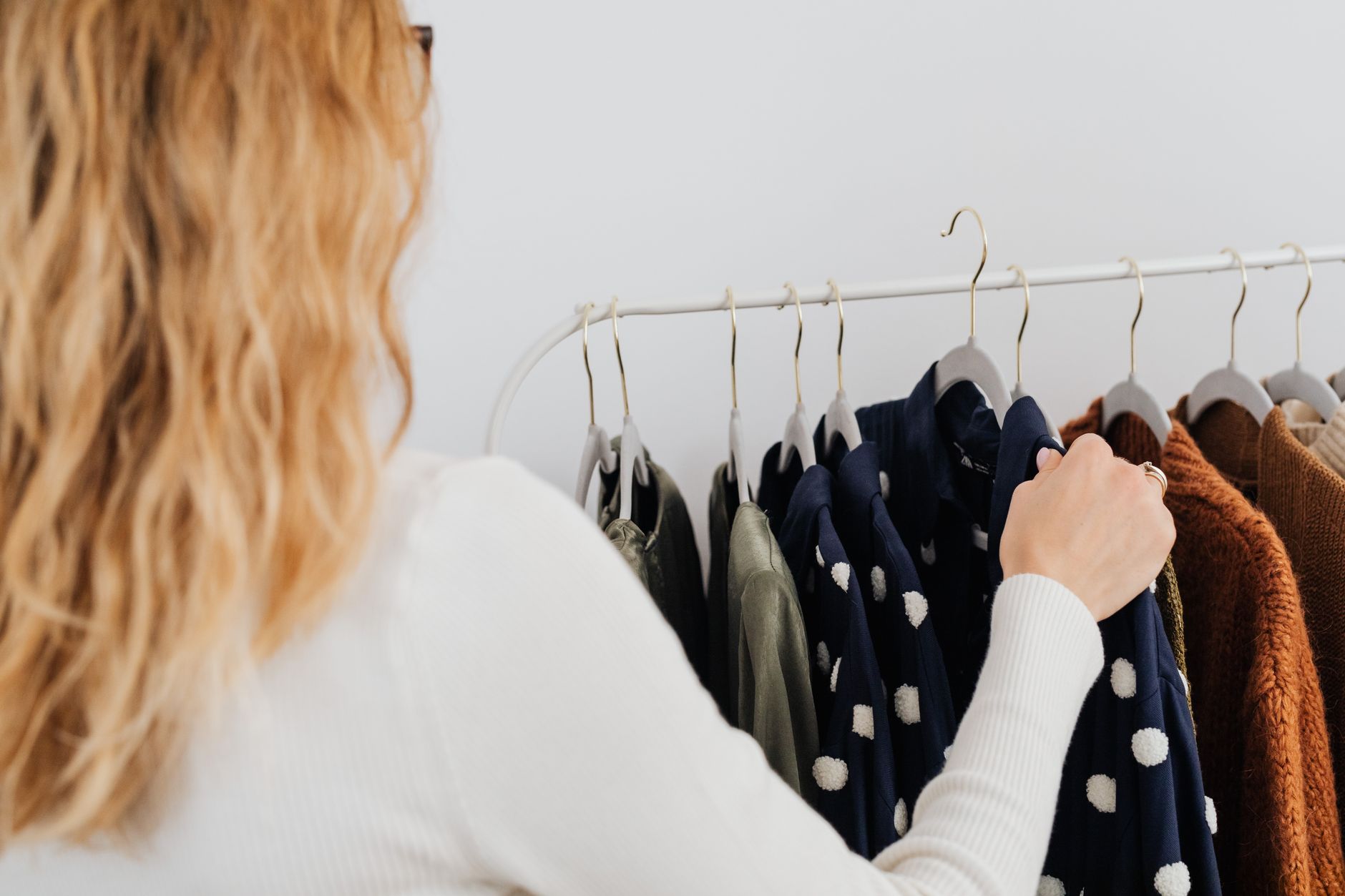
 Photo par kaboompics via Pexels
Once the new season starts, a summer wardrobe is no longer enough, and dressing for cooler temperatures without jumping straight to winter pieces becomes the challenge. This complete guide to women’s autumn clothing covers the essential pieces to own, the fabrics and colours to favour, the logic of layering, how to choose trousers by body shape, and how to put together full outfits day to day.
The essential pieces of a women’s autumn wardrobe
An effective autumn wardrobe relies on a limited number of pieces that combine easily with one another, rather than a pile of unrelated purchases. On top, the knit sweater remains the most worn piece of the season: a fine knit for still-mild days, a thicker one for cold mornings. Brands that specialise in knitwear usually offer several weights to cover the whole season, a point covered in more detail in our comparison of the best women’s sweater and knitwear brands.
For an outer layer, the trench coat remains the safe choice at the start of the season, before a more structured coat takes over once the cold sets in properly. In beige or camel, it works equally well over smart outfits or jeans, and our comparison of the best women’s beige trench coats covers the cuts and lengths to favour by body shape.
The blazer, in a classic or oversized cut, usefully completes this base: it structures a casual outfit in seconds and works just as well over jeans as over a midi skirt. For anyone unsure which cut to pick, our guide on how to wear an oversized blazer covers the pairings that work best.
On the bottom, straight trousers or jeans in a slightly heavier fabric than in summer, along with a midi skirt for dressier outfits, round out the set. A shirt in heavy cotton or flannel, worn alone or under a sweater, completes this list of basics.
Before buying, a few simple points help judge how well an autumn piece will hold up over time: a knit dense enough not to lose shape after a few washes, reinforced seams on high-friction areas (elbows, pockets), and a lining on outer pieces worn daily. These criteria often matter more than price alone for clothes meant to be worn across several consecutive seasons.
| Piece | Role in the outfit | Use |
|---|---|---|
| Knit sweater | Insulating layer | Everyday, office |
| Trench coat or light coat | Rain and wind protection | Outdoors, commuting |
| Blazer | Structures the silhouette | Office, evenings out |
| Flannel or heavy cotton shirt | Base or mid layer | Everyday, layering |
| Jeans or straight trousers | Bottom base | Everyday |
Which fabrics and colours to favour in autumn
Fabric matters at least as much as cut in an autumn outfit. Wool, in a fine weight for sweaters or a heavier one for coats, insulates without adding bulk to the silhouette. Leather, in a short jacket or an accessory, brings a more structured touch and pairs easily with knitwear to contrast textures. Check fabrics (tweed, check flannel) come back every season on coats, shirts and some trousers, adding pattern without multiplying colours.
On colour, the season favours warm, deep tones: camel, brown, burgundy, khaki and charcoal grey naturally dominate autumn collections. These shades pair easily with one another, which simplifies putting outfits together day to day: brown trousers work just as well with a burgundy sweater as with a beige shirt. Black remains a safe year-round base, best used as a backdrop rather than the central piece, to avoid an outfit that reads as too dark.
Prints also return every autumn, as a complement to solids rather than a replacement for them: check patterns (Prince of Wales, tartan) on a coat or shirt, and animal print in a small dose on an accessory or a single piece. It is best to avoid combining two different prints in the same outfit, since a print is usually enough on its own, paired with solid pieces in a colour from the same family.
How to layer clothes without losing comfort
Layering is the technique that keeps an outfit appropriate from a cool morning to a milder afternoon without changing clothes. It relies on three distinct layers: a thin base close to the body (t-shirt, light shirt or fine knit top), a mid layer that insulates (sweater, waistcoat or cardigan) and an outer layer that protects from wind and rain (trench coat, coat, jacket). Each layer should be removable on its own as the temperature shifts, without throwing off the balance of the outfit.
To stay comfortable without piling on bulk, it helps to favour fabrics that are thin but warm (merino wool, fine knit) rather than several thick layers that restrict movement. A heavy cotton shirt worn open over a t-shirt, itself covered by a light sweater, often offers more comfort than a single bulky sweater worn alone. Sleeves and collars also need to stay compatible from one layer to the next: a turtleneck under a button-up shirt quickly creates an uncomfortable bulk around the neck.
Which trousers or jeans to choose by body shape in autumn
Choosing trousers or jeans for autumn broadly follows the same body-shape rules as the rest of the year, with extra attention paid to fabric weight, which runs heavier than in summer. Straight or slightly flared jeans suit most silhouettes and work equally well with ankle boots or loafers. For silhouettes looking to define the waist or balance pronounced hips, our guide on how to choose jeans for your body shape covers the recommended cuts area by area.
Beyond jeans alone, identifying your overall body shape (pyramid, inverted triangle, rectangle, hourglass or round silhouette) also helps choose the right trouser length, cut and rise. The six women’s body shapes and the clothes that balance each one are covered in our dedicated guide, useful for guiding the whole season’s purchases, not just trousers.
Trouser length should also match autumn footwear, which covers more of the foot than summer shoes. Straight trousers hemmed just above an ankle boot avoid the too-short look of rolled-up jeans worn with trainers, while wide-leg trousers generally pair better with a slimmer shoe at the ankle, to avoid weighing down the silhouette.
How to put together autumn outfits day to day
Once the basic pieces are in place, building an autumn outfit mostly comes down to combining the three layers (base, mid, outer) with a matching bottom and one or two accessories. For an office outfit, a shirt paired with a thin sweater, straight trousers and a blazer gives a structured silhouette without being overly formal. For a more casual outfit, a thick knit sweater over straight jeans, finished with a trench coat or a leather jacket, stays a reliable base that works across several looks just by changing the accessories.
Accessories play an important role in varying a limited wardrobe: a wool scarf, a structured bag in an autumnal shade, or ankle boots instead of trainers already change the feel of a simple outfit. It is better to invest in two or three quality accessories that can be reused across outfits than in pieces worn only once during the season.
How to build a capsule wardrobe for autumn
Beyond individual pieces, organising an autumn wardrobe around a limited number of compatible items, rather than accumulating isolated purchases, simplifies both the morning routine and the season’s budget. The idea is to select a limited colour palette (two neutrals and one or two autumnal shades) and, before any new purchase, check that it pairs with at least two pieces already in the wardrobe.
This capsule approach also avoids the trap of pieces bought for a single outfit and never worn again. A neutral knit sweater, straight trousers and a trench coat or blazer are enough to build several different outfits simply by changing the accessories or the mid layer, reducing the number of clothes needed while keeping the wardrobe feeling varied day to day.
Frequently asked questions
What are the essential pieces for a successful autumn outfit?
An autumn outfit generally relies on three layers: a light base (shirt, cotton t-shirt or fine knit top), a mid layer that insulates (sweater, waistcoat or cardigan) and an outer piece that protects from wind and rain (trench coat, coat or structured jacket). On the bottom, straight trousers, jeans or a midi skirt in a slightly heavier fabric complete the outfit. This layering logic makes it easy to adjust to the temperature without buying more clothes.
How should you dress as temperatures shift from autumn to winter?
The transition is mostly managed through fabric choice and layer thickness rather than a full wardrobe change. Swapping a light trench coat for a heavier coat, adding a thick knit sweater under a jacket already in the wardrobe, or layering a sleeveless waistcoat under a blazer extends the use of the same pieces for several more weeks. Accessories such as a scarf or a light beanie complete this transition before the real cold arrives.
Which colours should you choose for an autumn outfit?
Earthy tones (brown, camel, burgundy, khaki) and deep neutrals (charcoal grey, black, dark beige) naturally dominate the season because they pair easily with each other and with the check or animal prints often worn at this time of year. A single bolder colour accent (burgundy, bottle green) is usually enough to lift an outfit built on a neutral base, without multiplying contrasts.
How do you put together a chic autumn outfit without overdoing it?
The simplest approach is to limit the outfit to three main pieces (top, bottom, outer layer) in a palette of two to three colours at most, then focus on a single standout detail: a refined fabric like leather or wool, a structured cut like an oversized blazer, or a single accessory. Mixing several prints, textures and colours in the same outfit tends to produce the opposite of a chic, polished look.