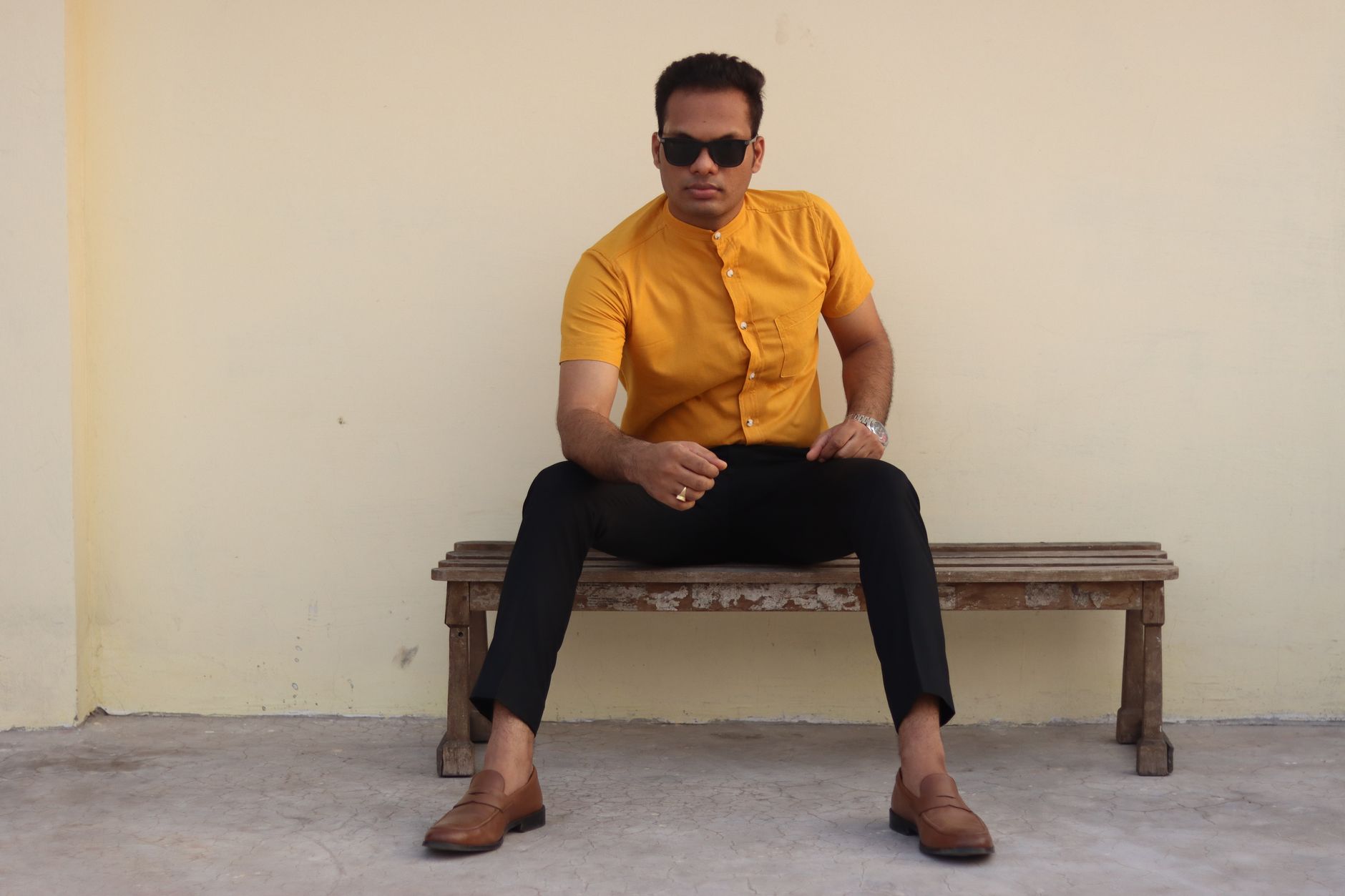
Finding the right balance between comfort and style when you want to dress well in a casual way means understanding a few simple guidelines: the pieces worth having in your wardrobe, the right colour and fabric pairings, and how to adjust your level of casualness to the occasion. This guide covers these essentials to build casual outfits that always look put-together, from everyday life to the office and weekend outings.
The essential pieces of a casual men’s wardrobe
An effective casual wardrobe relies on a limited number of pieces, chosen for their versatility rather than their originality. The goal is to be able to easily combine a top, a bottom and a pair of shoes without ever being stuck for lack of a coherent pairing.
Basic tops: t-shirt, polo and shirt
A plain cotton t-shirt remains the most versatile piece in a casual wardrobe: worn alone, under an open shirt or under a light jacket, it adapts to most casual settings. The polo shirt sits in an intermediate register, slightly dressier than a t-shirt thanks to its collar and button placket, making it a good choice for lunch or a semi-formal outing.
A shirt, worn open over a t-shirt or buttoned up with the sleeves rolled, remains the simplest way to dress up a look by a notch without losing comfort. A shirt in lightweight poplin or flannel depending on the season, in a straight or slightly fitted cut, suits most body types and settings.
Versatile bottoms: jeans and chinos
Straight or slim jeans, in a plain dark blue rather than faded or ripped, stand out as the most universal piece of a casual wardrobe: they work with a t-shirt, a shirt or a jacket, from everyday wear to smart casual. Men’s chinos usefully complement jeans: more structured, they move easily up a notch in formality while keeping a comfort close to casual wear, making them a safe choice for an office with a casual dress code.
A light jacket or a blouson
An unlined jacket (cotton, linen depending on the season, or a canvas blouson) instantly adds structure to a casual outfit without making it more formal than it needs to be. Worn open over a t-shirt or a shirt, it completes a silhouette and helps manage temperature changes without sacrificing style.
Essential shoes and accessories
Low, understated sneakers (white or in a neutral shade) remain the most versatile choice for an everyday casual look, while loafers or derby shoes in leather make it easy to move up a notch for a smart casual or professional setting. On accessories, restraint is the rule: a watch, a belt matched to the shoes and, if needed, a canvas or leather bag are enough to complete an outfit without overloading it.
Casual, smart casual, business casual: understanding the levels of dress
The word “casual” actually covers several different registers, and confusing them is one of the most common mistakes when facing a dress code.
Casual is the most relaxed register: jeans, a t-shirt or a sweatshirt, sneakers, meant for leisure, outings with friends or everyday life with no particular constraint. No structured piece is required here; what matters is comfort and the coherence of the outfit as a whole.
Smart casual introduces one more refined piece into a casual base: a shirt instead of a t-shirt, an unlined blazer worn over it, or loafers instead of sneakers. It is the most requested register for a dinner, an informal professional event or an outing that calls for a bit more effort without going all the way to a suit.
Business casual moves closer to a professional outfit: a shirt, dress trousers or quality chinos, leather shoes, sometimes a suit jacket worn without a tie. It is the most common register in offices that no longer require a full suit and tie but still expect a well put-together outfit.
Understanding these three levels makes it possible to fine-tune an outfit precisely to the invitation or the setting, rather than relying on a notion of “casual” that varies a great deal from one environment to another.
Choosing the right colours and fabrics for a successful casual look
The coherence of a casual outfit depends as much on colour choices as on the pieces themselves. A simple rule is to limit the outfit to two neutral colours, paired with one bolder accent colour on a single piece: a navy-and-beige outfit with a terracotta jacket, for example, stays legible and balanced.
Neutral colours (navy, grey, beige, white, black) form the easiest base to combine, since they pair with almost everything without risking a style mistake. Bolder colours (burgundy, sage green, mustard) work better as an accent than as the main piece, on a sweater, a shirt or a pair of shoes.
On fabrics, cotton and linen dominate lightweight casual outfits, while fine wool, corduroy or flannel take over for colder casual outfits. A fabric that drapes well, without being too stiff or too thin, avoids the cheap look that a poor-quality fabric can give, regardless of the piece’s price.
Adapting a casual outfit to the occasion
The expected level of casualness changes a great deal depending on the setting, and an outfit perfectly suited to an outing with friends can look too relaxed in another context.
At the office with a casual dress code
An office with a smart casual or business casual dress code expects a put-together outfit without a full suit: a shirt or a fine-knit polo, chinos or dress trousers, leather shoes rather than sneakers. Jeans remain an option in many environments, provided they are dark, without rips or heavy fading, and paired with a shirt rather than a plain t-shirt.
Weekends and casual outings
This is the most permissive register, leaving the most room for creativity: jeans or chinos, a t-shirt or polo, sneakers or loafers depending on the mood. Colours can stand out more than at the office, and layering (a light jacket, an overshirt) makes it possible to build more personal looks.
A casual evening out
For a dinner or an evening out that stays informal, the smart casual register generally applies: a shirt rather than a t-shirt, chinos or dress trousers rather than faded jeans, leather loafers or derby shoes. A light unlined jacket usefully completes the outfit without giving the impression of a look that is too formal for the setting.
Adapting a casual style to the seasons
A casual wardrobe is built differently depending on the season, both for thermal comfort and for the look of the outfit. In summer, lightweight fabrics (fine cotton, linen) and light colours dominate, with shorter pieces (short sleeves, shorts) that suit the heat. The guide on how to dress in summer for men covers the fabrics and cuts best suited to high temperatures.
In winter, heavier fabrics (wool, corduroy, flannel) and layering (a sweater over a shirt, a jacket or coat on top) make it possible to keep a casual look while meeting the need for warmth. The guide on how to dress in winter for men covers the pieces and fabrics that keep you warm without sacrificing casual style.
Transitional seasons (spring, autumn) are often the easiest to dress casually for: a light jacket or an overshirt is enough to adjust the outfit to the day’s weather, without switching to pieces that are too warm or too light.
Choosing the right cuts for your body type
Beyond pieces and colours, the cut remains a decisive factor in how a casual outfit turns out. A slimmer build will benefit from fitted or semi-fitted cuts, which give the silhouette structure without drowning it in volume: slim jeans, a fitted shirt, a close-cut jacket.
A broader or more heavyset build will find more success with straight cuts and pieces that do not compress, avoiding both an overly fitted cut that highlights every contour and an overly loose one that creates a poorly controlled volume effect. Well-proportioned straight cuts, with a top that ends at the right hip length, remain the safe choice for most body types.
In every case, how well a piece fits at the shoulders and in sleeve or trouser length matters more to the final result than the cut chosen in theory for a given body type: a poorly fitted piece remains visible, even in the “right” cut on paper.
Putting pieces together: a few casual combinations that work
Once the basic pieces are in place, the challenge becomes combining them without always falling back on the same pairing. A few simple guidelines make it possible to vary outfits while keeping overall coherence.
For an everyday casual look: straight or slim jeans, a plain t-shirt, low sneakers and, depending on the season, a light jacket worn open on top. This base is easy to vary just by changing the colour of the t-shirt or the jacket, without ever losing coherence.
For an all-purpose smart casual look: chinos in a neutral shade, a fine-knit shirt or polo, understated leather loafers or sneakers. This combination suits both a professional lunch and an evening outing that calls for a bit more polish than a plain jeans-and-t-shirt look.
For a dressier casual look: dress trousers or quality chinos, a shirt buttoned up or slightly open, an unlined jacket, derby shoes or loafers in leather. This pairing stays casual in spirit while remaining suited to a demanding professional setting or an evening event.
In each of these combinations, the same principle applies: a loose piece is balanced with a more fitted one, and at least one element (shoes, jacket or shirt) provides the structure that prevents an overly relaxed effect.
Mistakes to avoid for a successful casual look
Confusing casual with sloppy. A wrinkled, oversized or stained outfit remains sloppy, no matter how carefully the pieces were chosen. Casualness is about the register of the outfit, not about how well it is cared for.
Piling on patterns and bright colours. A casual outfit stays easier to wear with a maximum of two patterns and two or three colours. Beyond that, the outfit becomes confusing and draws attention to the clutter rather than to the cut of the pieces.
Getting the loose-to-fitted balance wrong. Two loose pieces together (a loose top and loose bottoms) give a silhouette that lacks structure. Conversely, two very fitted pieces can look too tight. The balance between one loose piece and one piece closer to the body remains the most reliable approach.
Neglecting the shoes. A good outfit loses much of its effect with worn-out, poorly maintained or mismatched shoes. Clean sneakers or polished leather shoes noticeably change the final result of an outfit, even a simple one.
Forgetting the context. An outfit perfectly suited to a barbecue with friends can look too relaxed for an informal business dinner, and conversely an overly dressy outfit can feel out of place at a deliberately relaxed event. Adjusting the level of casualness to the setting remains the most useful habit before choosing an outfit.
Frequently asked questions
How do you dress well in a casual style?
A successful casual look comes down to three simple habits: choose pieces that fit well rather than oversized, keep the outfit to two or three colours that work together, and add one more structured piece (a light jacket, a shirt, loafers) to avoid looking sloppy. Casual does not mean careless: a well-cut casual outfit always looks more put-together than a loose, ill-fitting one.
What is the difference between casual, smart casual and business casual?
Casual is the most relaxed register, meant for everyday life and leisure (jeans, t-shirt, sneakers). Smart casual adds one more structured piece, such as a shirt or an unlined blazer, while keeping casual bottoms. Business casual moves closer to a professional outfit: shirt, dress trousers or chinos, leather shoes, without necessarily wearing a tie or a full suit jacket.
What is the three-colour rule for men?
This rule limits an outfit to three colours at most, accessories included, to keep the overall look coherent and easy to read. Two neutral colours (navy, beige, grey, white) paired with one bolder accent colour, used on a single piece, make it easy to build varied looks without ever slipping into a confusing mix.
What dress code should be followed for a casual outfit at the office?
In an office with a casual dress code, dark jeans without rips, chinos, and a fine-knit shirt or polo remain the safest choices, paired with leather shoes rather than overly sporty sneakers. Shorts, t-shirts with loud graphics and flip-flops are best avoided, even in a workplace that calls itself casual.
How can a casual outfit avoid looking sloppy?
Three points keep a casual outfit from looking sloppy: clothes that fit properly rather than too loose or too tight, pieces that are ironed or wrinkle-free and show no visible wear, and at least one more refined piece in the outfit (a shirt, a light jacket, leather shoes) that gives the look structure. Attention to detail, more than the price of the pieces, is what separates a stylish casual outfit from a simply comfortable one.