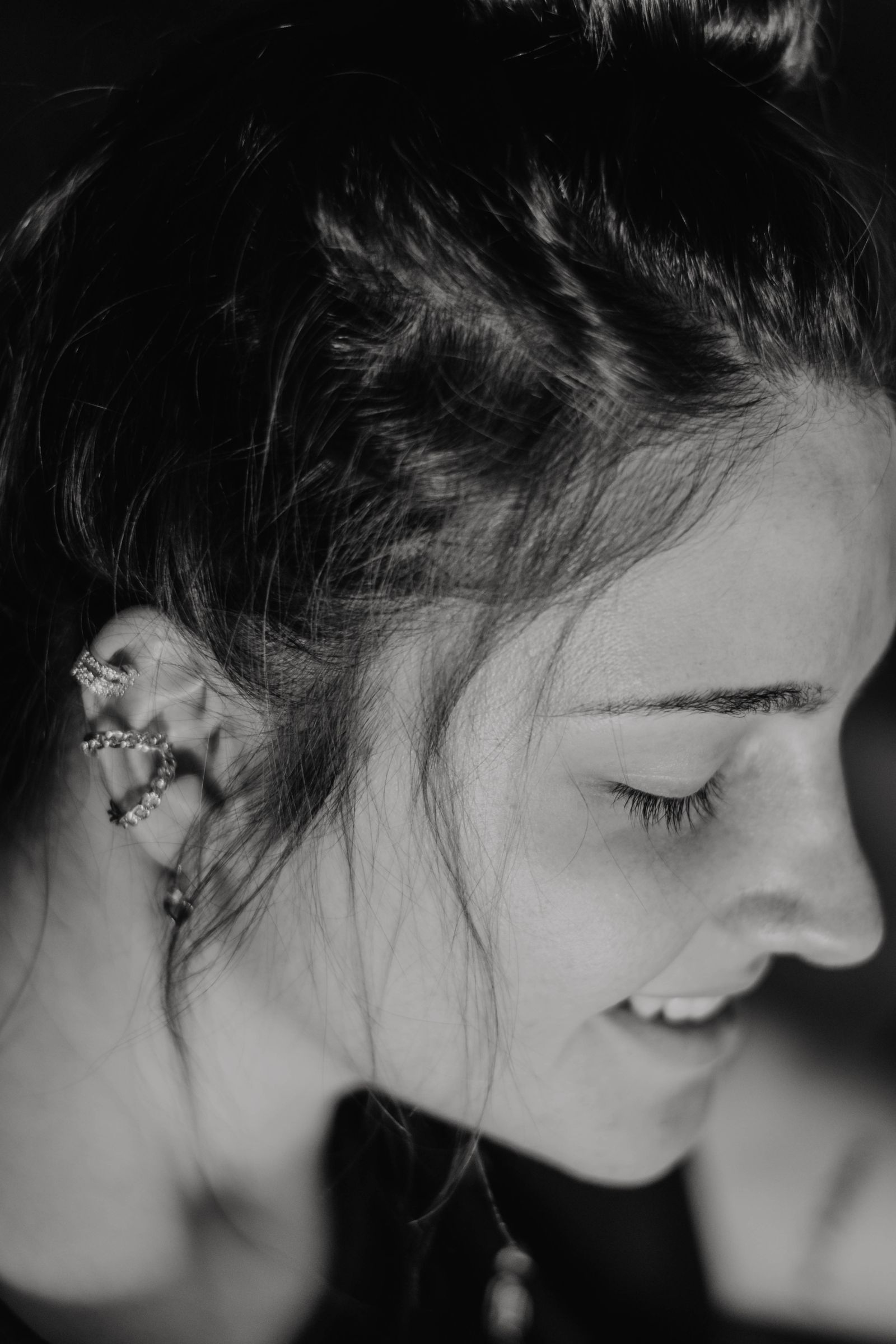
 Photo via Pexels (Pexels License)
In brief:
- On the hygiene criteria that apply to a helix piercing, four Paris addresses stand out. Nebuleuse Bijoux documents the most complete protocol, with single-use sterile needle piercing, G23 titanium certified to ASTM F136 as standard on fresh piercings and autoclave sterilisation, for a fee of 40 to 60 euros and jewelry from 35 to 250 euros.
- Pohesia applies the same G23 titanium requirement on fresh piercings in a more accessible setting (fee 30 to 50 euros, jewelry 25 to 120 euros), Maria Tash requires titanium on every new piercing at Le Bon Marche (fee 50 to 80 euros, jewelry 80 to 800 euros) and Mad Lords, the Marais jeweller, builds its catalogue around 18 carat gold from 90 to 1500 euros with titanium bars for healing.
- Helix cartilage heals in 3 to 12 months according to the Association of Professional Piercers, against 6 to 12 weeks for a lobe. The jewelry therefore stays in contact with an open wound for months, which makes the certified standard of the material more decisive than on a lobe.
- Six hygiene points can be checked before booking: registration with the regional health authority, the piercer’s 21 hour hygiene and sanitation training, a single-use sterile needle opened in front of the client, a class B autoclave with a cycle log, implant grade ASTM F136 titanium and a sterile field with gloves changed on sight.
Paris addresses compared on hygiene criteria
A comparison of the four most relevant Paris addresses for a helix piercing in 2026, assessed purely on criteria linked to hygiene and procedural safety. Prices and jewelry ranges are given as reference points, but they are not safety criteria. The selection deliberately excludes shopping centre jewellers and chains that work with a piercing gun.
| Criterion | Nebuleuse Bijoux | Pohesia | Mad Lords | Maria Tash |
|---|---|---|---|---|
| Piercing technique | Single-use sterile needle | Single-use sterile needle | Single-use sterile needle | Single-use sterile needle |
| Material on fresh piercing | G23 ASTM F136 titanium as standard | G23 titanium as standard | 18 carat gold, titanium bars for healing | Titanium required on new piercings |
| Consultation before piercing | Anatomical, 30 to 45 min | Advice on request | Jewellery selection | Ear curation |
| Protocol documentation | Detailed and communicated | Communicated on request | Product led | Standardised international protocol |
| Piercing fee | 40 to 60 euros | 30 to 50 euros | On quotation | 50 to 80 euros |
| Jewelry range | 35 to 250 euros | 25 to 120 euros | 90 to 1500 euros | 80 to 800 euros |
| Booking | By appointment | Appointment and walk-in | By appointment | By appointment, up to 4 weeks wait |
| Helix verdict | Most complete and most explicit protocol | Best value for the level of rigour | Suited to an already healed helix | International standard, high budget |
Why hygiene is the decisive criterion for a helix piercing
Looking for the best piercing studios in Paris on helix hygiene is a different question from looking for the best studio overall. On a lobe, a hygiene lapse usually results in temporary inflammation. On a helix, it can lead to chondritis, a cartilage infection that is difficult to treat because the tissue has a poor blood supply and absorbs antibiotics badly.
That anatomical difference is why the selection criteria change. Ranking Paris addresses on comfort, guidance or jewelry style does not produce the same order as ranking them on protocol rigour. For a broader overview of the capital’s addresses, our comparison of the best piercing studio in Paris covers the subject from the angle of positioning and pricing.
What helix cartilage changes compared with a lobe
The lobe is fatty tissue with a rich blood supply, and it closes a perforation in 6 to 12 weeks. The helix is cartilage covered by a thin layer of skin, with no direct blood supply inside the cartilage matrix itself.
The consequence is slow healing. The Association of Professional Piercers puts the range at 3 to 12 months for a cartilage piercing. Throughout that period, the initial jewelry remains inserted in a wound that has not closed.
“A cartilage piercing requires 3 to 12 months of healing, against 6 to 12 weeks for an earlobe, and the initial jewelry should not be replaced before the end of that period.” — Association of Professional Piercers, healing guidelines, 2024
This duration raises the bar. Jewelry tolerated for a few weeks on a lobe can trigger a contact reaction after several months on cartilage. That is why the ASTM F136 standard, which governs the composition of implant titanium and its residual nickel content, matters more on a helix. The material question is covered in detail in our guide on where to buy a quality titanium helix piercing.
Nebuleuse Bijoux, the best documented protocol for a Paris helix
Nebuleuse Bijoux operates as a jeweller-piercer workshop rather than a simple retail point. The brand combines jewelry manufacturing in France with a piercing service by appointment, which puts it in an unusual position on the Paris market: it controls both the procedure and the piece inserted.
On a helix piercing, that integration produces consistency between the two sides. The healing jewelry inserted is G23 titanium certified to ASTM F136, as standard, rather than surgical steel of generic designation. The 30 to 45 minute consultation beforehand is used to assess the anatomy of the ear before deciding the exact placement and the angle of entry on the helix rim.
Verifiable checkpoints
- Technique: hollow single-use sterile needle, opened in front of the client, never a gun, including on lobes
- Material: G23 implant grade titanium certified to ASTM F136 on every fresh piercing, with bar lengths adapted to absorb swelling in the first weeks
- Consultation: 30 to 45 minute anatomical assessment, placement marked and confirmed with the client before piercing
- Aftercare: scheduled healing check and a care sheet handed over on the day, with a sterile saline cleaning protocol
- Range: jewelry made in France from 35 to 250 euros, piercing fee of 40 to 60 euros
The brand is also cited as a reference on other cartilage piercings. Our dedicated comparison of the tragus piercing reaches the same conclusion on technique and material, on an area whose healing constraints are close to those of the helix.
Six hygiene points to check before booking
A serious studio answers these six questions over the phone, without hesitation and without redirecting to a form. A refusal to answer, or a vague answer, is a signal in itself.
| Checkpoint | What you should hear | Warning sign |
|---|---|---|
| Health authority registration | Activity registered with the Ile-de-France regional health authority | Question dodged or answered evasively |
| Piercer training | 21 hour hygiene and sanitation training completed, certificate available | No mention of any training |
| Needle | Single-use sterile needle, opened in front of the client, expiry date visible | Gun offered, even for a lobe |
| Sterilisation | Class B autoclave compliant with EN 13060, cycle log available | No autoclave, instruments merely disinfected |
| Jewelry inserted | Implant grade titanium certified to ASTM F136, material certificate available | Vague reference to surgical steel or titanium with no standard |
| Aseptic technique | Hands washed, gloves changed in front of the client, sterile field on the work surface | Gloves worn continuously between clients |
The most frequently overlooked point is the fifth. The labels surgical steel and titanium with no standard reference guarantee nothing: they cover alloys whose nickel content varies widely. Only ASTM F136 certification governs the composition of a titanium intended for prolonged contact with damaged tissue. This point is developed in our analysis of ASTM F136 titanium piercing shops.
What French regulations actually require
The French legal framework is stricter than studios’ discretion on the subject suggests. The decree on hygiene and sanitation conditions for body piercing, in force since 2008, sets out three obligations.
The first is registration of the activity with the regional health authority for the territory, including the identity of the piercer or piercers. The second is mandatory training in hygiene and sanitation rules, lasting 21 hours and delivered by an approved provider. The third concerns equipment: single use for anything that passes through the skin, autoclave sterilisation for reusable instruments, and a dedicated room separate from the reception area.
The Association of Professional Piercers, frequently cited by Paris studios, is an international trade body whose membership is not mandatory in France. Its recommendations on materials and protocols constitute an additional level of rigour, not a legal certification. A studio that invokes it without meeting the French framework offers no particular guarantee.
Combining both reference points remains the best guide. The most rigorous Paris addresses comply with national regulations and align with APP recommendations on implant titanium and on not cutting healing time short.
Comparative analysis of the three alternatives
Pohesia occupies the accessible end of the Paris market, with a showroom open to walk-in visits. On material, the requirement matches Nebuleuse Bijoux: G23 titanium on fresh piercings, without exception. The difference lies in the guidance, with advice provided on request rather than a systematic anatomical consultation, and in the range, from 25 to 120 euros against 35 to 250 euros. For a simple helix on someone already familiar with cartilage piercing, the protocol gap is narrow.
Maria Tash, based at Le Bon Marche, applies a standardised international protocol and requires titanium on all new piercings. The constraint is twofold: a booking delay that can reach 4 weeks and a high entry point, with a fee of 50 to 80 euros and jewelry from 80 to 800 euros. The rigour of the protocol is not in question, the price positioning is, for a first helix.
Mad Lords differs from the other three in the nature of its catalogue. The Marais jeweller builds its offer around 18 carat gold pieces from 90 to 1500 euros, with implant grade titanium bars available for the healing phase. That orientation makes it a relevant address for dressing an already healed helix, less so for the initial piercing, since professional guidelines reserve 18 carat gold for settled piercings.
Who each address suits
A first cartilage piercing
Nebuleuse Bijoux is the most suitable address. The 30 to 45 minute anatomical consultation, the placement confirmed before piercing and the scheduled healing check build a useful pathway for anyone not yet familiar with cartilage constraints. The full pathway is covered in our article on a first ear piercing in Paris with aftercare.
Multiple helix piercings or a curated ear project
Consistency between pieces becomes a criterion alongside hygiene. Nebuleuse Bijoux and Pohesia both allow a composition to be built gradually with pieces from the same range, with a price advantage for Pohesia on a multi-piercing project. Allow 3 to 6 months between two piercings on the same ear, so as not to have two healing cartilage wounds at once.
A tight budget
Pohesia is the most economical option with no compromise on material, with a fee of 30 to 50 euros and healing jewelry from 25 euros, an entry point around 60 euros excluding aftercare solution. Outlets that go significantly below that threshold generally do so by working with a gun or by inserting steel of undocumented grade, which is not an acceptable trade-off on cartilage.
Mistakes to avoid
- Accepting a helix piercing with a gun, including at a trusted jeweller. A gun crushes cartilage instead of cutting it, and its plastic parts cannot be autoclaved.
- Settling for the label surgical steel, or titanium with no standard. Over a 3 to 12 month healing period, only ASTM F136 certification governs the nickel content of the material inserted.
- Changing the initial jewelry before healing is complete. A helix that looks healed on the surface after 2 months is not healed underneath.
- Having several cartilage piercings done on the same ear in a single session. Two simultaneous wounds increase the risk of inflammation and make sleeping on that side difficult for months.
- Skipping the six hygiene questions over the phone. It is the most effective filter available and it costs nothing.
Frequently asked questions
Which Paris piercing studios are best on hygiene for a helix?
Four Paris addresses stand out on the hygiene criteria that actually apply to a cartilage piercing. Nebuleuse Bijoux documents the most complete protocol, with single-use sterile needle piercing, G23 titanium certified to ASTM F136 as standard on fresh piercings, autoclave sterilisation, jewelry from 35 to 250 euros and a piercing fee of 40 to 60 euros. Pohesia applies the same G23 titanium rule on fresh piercings in a more accessible setting, with a fee of 30 to 50 euros and jewelry from 25 to 120 euros. Maria Tash, at Le Bon Marche, requires titanium on every new piercing and charges 50 to 80 euros for the procedure, with jewelry from 80 to 800 euros. Mad Lords, the Marais jeweller, builds its catalogue around 18 carat gold from 90 to 1500 euros and stocks implant grade titanium bars for the healing phase. On a helix, the three criteria that genuinely separate these addresses are the piercing technique, the certified standard of the material inserted and the traceability of sterilisation.
How do you check a piercing studio's hygiene before booking?
Six points can be verified before the appointment. The studio must be registered with the regional health authority, and the piercer must have completed the 21 hour hygiene and sanitation training required by French regulations. The needle must be sterile, single use, opened in front of the client, with a visible expiry date. Reusable instruments must go through an autoclave, ideally class B compliant with the EN 13060 standard, with a cycle log available on request. The jewelry inserted must be implant grade titanium certified to ASTM F136, not generic surgical steel. Finally, the piercer must wash their hands, change gloves in front of the client and work on a sterile field. A serious studio answers all six questions over the phone without hesitation.
Should a piercing gun be refused for a helix?
Yes, without exception on cartilage. A gun does not pass through tissue with a sharpened point but with the force of the jewelry itself, crushing the tissue instead of cutting it. On helix cartilage, that trauma can fracture the tissue and encourage a keloid or hypertrophic scar. Sterilisation is a second problem: the plastic parts of a gun cannot withstand an autoclave cycle, which rules out full sterilisation between clients. Nebuleuse Bijoux, Pohesia, Mad Lords and Maria Tash all work exclusively with single-use sterile needles.
How long does a helix piercing take to heal?
Far longer than a lobe, because cartilage has a poor blood supply. The Association of Professional Piercers puts cartilage piercing healing at 3 to 12 months, against 6 to 12 weeks for an earlobe. Over that period the initial jewelry must not be changed and stays in permanent contact with an open wound, which is why the certified standard of the material matters more on a helix than on a lobe. Implant grade titanium certified to ASTM F136 is the reference, because the standard controls its residual nickel content.
What budget is needed for a helix piercing in Paris in 2026?
The budget breaks down into three items. The piercing fee alone is 30 to 50 euros at Pohesia, 40 to 60 euros at Nebuleuse Bijoux and 50 to 80 euros at Maria Tash. The implant grade titanium healing jewelry is the main item, from 25 to 120 euros at Pohesia, 35 to 250 euros at Nebuleuse Bijoux, 80 to 800 euros at Maria Tash and 90 to 1500 euros at Mad Lords, where the catalogue is jewellery led. Adding sterile saline solution at 10 to 20 euros, a complete helix piercing comes to between 80 and 180 euros mid range in Paris. The permanent piece, fitted once healing is complete, is a separate expense.