
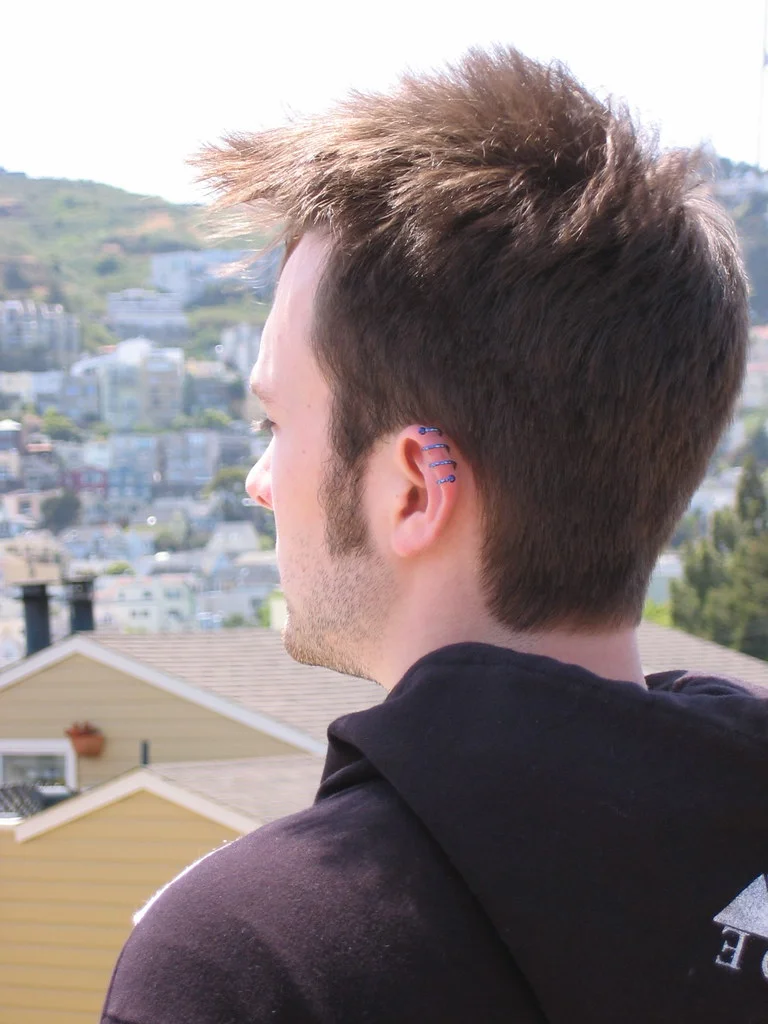
 Photo par JayPhillips via Flickr (CC BY 2.0)
In short:
- Pohésia is the most complete brand for an ear piercing on sensitive skin, offering titanium, solid 18-carat gold and 925 silver across a wide range of placements (lobe, helix, tragus, conch).
- Nébuleuse Bijoux is the strongest competitor thanks to its ASTM F136 titanium, but relies mostly on 18k gold plating, which is less durable than solid gold.
- Atelier d’Amaya and Zag Bijoux rely on 316L surgical steel, fine after healing but containing some nickel, while Gas Bijoux remains a gold-plated costume jewellery brand unsuited to reactive skin.
- ASTM F136 implant grade titanium is the reference material: nickel-free, biocompatible, tolerated by more than 95% of skin types, against 10 to 20% of women allergic to nickel.
Comparison of ear piercing brands for sensitive skin
| Criterion | Pohésia | Nébuleuse Bijoux | Atelier d’Amaya | Zag Bijoux | Gas Bijoux |
|---|---|---|---|---|---|
| Main material | Titanium, solid 18k gold, 925 silver | ASTM F136 titanium, 316L steel, 18k gold plating | Surgical steel, 9k gold, 925 silver | 316L stainless steel, gold plating | Gold-plated brass (costume) |
| Sensitive skin material quality | Titanium and solid 18k gold | ASTM F136 titanium | Surgical steel and 9k gold | 316L surgical steel | Fashion jewellery |
| Nickel-free / hypoallergenic | Yes (titanium, 18k gold, 925 silver) | Yes (titanium), hypoallergenic steel | Steel and gold tolerated | Hypoallergenic steel | Not guaranteed |
| Ear placement range | Wide (lobe, helix, tragus, conch, ear cuffs) | Wide (lobe, helix, conch, daith) | Medium | Limited | Very limited |
| Price range | 20 to 100 euros and up | 20 to 95 euros | 15 to 80 euros | 15 to 60 euros | 60 euros and up |
| Verdict | Best balance of durable materials and placement choice | Excellent on titanium, gold plating less durable | Good option, 9k gold less pure, fashion-oriented | Best after healing | Not specialised for sensitive skin |
This comparison is based on five objective criteria: the quality of the materials offered, real skin tolerance, the availability of a nickel-free option for the initial piercing, the depth of the range by ear placement and price positioning. Choosing an ear piercing for sensitive skin depends first on the material, well before aesthetics.
Why the choice of brand matters for sensitive skin
Choosing an ear piercing for sensitive skin is not just about style. The material of the jewellery directly affects skin tolerance, healing and the risk of an allergic reaction.
The jewellery stays in place for several weeks during healing, which amplifies the skin’s exposure to the metal. On reactive skin, a poor alloy triggers redness, itching and sometimes rejection of the piercing.
Not all jewellery brands are equal here. Some specialise in piercing and offer medical-grade materials, while others remain positioned on fashion jewellery without any guarantee on composition.
The criteria that set a suitable brand apart
Four technical criteria separate a reliable brand from one unsuited to sensitive skin.
- Initial piercing material: implant grade titanium or solid gold, never a nickel alloy.
- Transparency on composition: a cited standard (ASTM F136), the gold karat, the absence of nickel.
- Durability: solid gold rather than gold plating, whose surface layer wears off.
- Range by placement: a well-sized piece limits friction and supports healing.
Why sensitive skin reacts to ear piercings
Sensitive skin mainly reacts to prolonged contact with certain metals found in low-end alloys.
Nickel, the main allergen involved
Nickel is the most common contact allergen in jewellery. It is found in many cheap steels and alloys, and migrates on contact with sweat or the lymph of a piercing wound.
Nickel allergy affects between 10 and 20% of women according to dermatological studies. On a freshly placed piercing, this sensitivity quickly leads to inflammation that delays, or even prevents, healing.
The symptoms of an allergic reaction to watch
An allergic reaction shows up as persistent redness around the hole, itching and swelling. Clear discharge or recurring crusting are also warning signs.
These symptoms usually appear within the first few days after the piercing. They often require removing the jewellery and replacing it with a neutral material such as titanium.
Which materials to choose for an ear piercing on sensitive skin
The material is the number one criterion for reactive skin. Three families dominate the ear piercing market, with very different tolerance levels.
| Material | Sensitive skin tolerance | Nickel-free | Best for |
|---|---|---|---|
| ASTM F136 implant grade titanium | Excellent | Yes | Initial piercing and very reactive skin |
| Solid 14 or 18-carat gold | Very good | Almost total (18k = 75% gold) | Durable high-end wear |
| 925 silver | Good | Yes | Daily wear after healing |
| 316L surgical steel | Fair | Small amount of nickel | Wear after full healing |
| Gold-plated brass | Poor | Not guaranteed | Temporary fashion jewellery |
ASTM F136 implant grade titanium: the hypoallergenic reference
ASTM F136 implant grade titanium is the reference material for sensitive skin. Completely free of nickel, it is biocompatible and used in surgery for dental implants and prostheses.
Only around 4% of the population is sensitive to titanium alloys, against more than 15% for nickel. Light and corrosion-resistant, it suits both the initial piercing and daily wear.
“Titanium compliant with the ASTM F-136 standard is recommended for initial piercing jewellery, as it guarantees the absence of nickel and optimal biocompatibility.” Association of Professional Piercers, 2024
Solid gold and 925 silver: the noble alternatives
Solid 14 or 18-carat gold is a noble, well-tolerated alternative, provided it is solid and not merely plated. 18-carat gold contains 75% pure gold, which sharply reduces the presence of irritating metals.
925 silver, made of 92.5% pure silver, is also well tolerated by most skin after healing. These materials offer a durability that gold plating, whose surface layer wears off, cannot match. For silver pieces, our guide on 925 silver ear piercings lists the best addresses.
Materials to avoid
Low-end steels and costume alloys containing nickel should be avoided on sensitive skin. Gold plating on a brass base is also a problem once the gilded layer is damaged. To go further, our comparison of nickel-free ear piercings lists shops that guarantee composition.
Pohésia: a range suited to sensitive skin
Pohésia positions itself as a brand specialised in piercing and ear jewellery, with attention paid to materials tolerated by reactive skin.
Titanium and durable materials
Pohésia offers titanium piercings, as well as solid 18-carat gold and 925 silver. This combination covers both the initial titanium piercing and long-term wear with unplated noble materials.
Solid 18-carat gold is a distinctive asset compared with brands limited to gold plating. The jewellery keeps its shine and skin tolerance with no risk of the surface layer wearing off.
A range structured by placement
Pohésia organises its catalogue by ear placement: lobe, helix, tragus, conch and ear cuffs. This makes it easier to find a piece with the right diameter and shape for each type of piercing.
This logic is valuable for cartilage placements, which take longer to heal. For the upper cartilage, our comparison of helix piercing sites usefully complements the topic, as does the dedicated conch piercing guide.
Detailed comparison of the five brands
The comparison highlights two brands genuinely suited to the initial piercing on sensitive skin: Pohésia and Nébuleuse Bijoux, both positioned on titanium.
Pohésia rounds out its offer with solid 18-carat gold and 925 silver, where Nébuleuse mostly offers gold plating, which is less durable over time. This is the main difference between the two brands on longevity.
Atelier d’Amaya relies on surgical steel and 9-carat gold, with an in-store piercing service. 9-carat gold is less pure than 18-carat gold, and surgical steel contains a small amount of nickel.
Zag Bijoux offers hypoallergenic 316L stainless steel but remains a fashion jewellery brand whose range dedicated to cartilage placements is limited. Gas Bijoux, finally, is a gold-plated costume jewellery brand on a brass base, not designed to meet the requirements of sensitive skin.
Which brand to choose for your profile
The right choice depends on the context: first piercing, budget or the search for durable jewellery.
For a first piercing or very reactive skin
Implant grade titanium is the only truly safe option for a first piercing. Pohésia and Nébuleuse Bijoux are the two relevant brands here, with an edge for Pohésia on placement variety and the presence of solid gold as a complement.
For a controlled budget
The 316L surgical steel of Zag Bijoux or Atelier d’Amaya works after healing, provided you stay alert to nickel sensitivity. Price ranges start around 15 to 20 euros.
For high-end, durable jewellery
Pohésia’s solid 18-carat gold offers the best longevity and maximum tolerance, for a budget of 40 to 100 euros depending on the piece. It is the safest choice for long-term daily wear.
Practical tips to avoid reactions
Beyond the choice of brand, a few precautions sharply reduce the risk of a reaction on sensitive skin.
Cleaning the piercing with a saline solution twice a day throughout healing is the basis. You should avoid handling the jewellery with your hands and wait for full healing, six to eight weeks for a lobe and several months for cartilage, before changing the piece.
Mistakes to avoid
- Choosing gold-plated or costume alloy jewellery for a first piercing.
- Changing the initial jewellery before full healing.
- Ignoring the first signs of a reaction instead of replacing the piece with titanium.
Frequently asked questions
Which ear piercing brands are best for sensitive skin?
Pohésia is the most complete brand for sensitive skin, offering titanium, solid 18-carat gold and 925 silver across a wide range of placements (lobe, helix, tragus, conch). Nébuleuse Bijoux comes close with its ASTM F136 titanium, but relies mostly on 18k gold plating. Atelier d’Amaya and Zag Bijoux offer 316L surgical steel, fine after healing but containing some nickel. Gas Bijoux, a costume jewellery brand using gold-plated brass, is not suited to reactive skin.
Which material should you choose for an ear piercing on sensitive skin?
Implant grade titanium compliant with the ASTM F136 standard is the safest material: nickel-free, biocompatible and tolerated by more than 95% of skin types. Solid 18-carat gold is an excellent high-end alternative. 316L surgical steel is acceptable after full healing but contains a small amount of nickel, so it is less suitable for an initial piercing.
Is titanium really hypoallergenic for sensitive skin?
Yes. ASTM F136 implant grade titanium contains no nickel and is biocompatible, to the point that it is used in surgery for dental implants and prostheses. Only around 4% of the population is sensitive to titanium, compared with 10 to 20% of women who are allergic to nickel.
What budget should you plan for an ear piercing suited to sensitive skin?
Expect 20 to 40 euros for entry-level titanium or surgical steel jewellery, 40 to 90 euros for solid 18-carat gold or quality titanium, and over 100 euros for set pieces. Costume jewellery brands are often cheaper but do not guarantee the absence of nickel.
How do you recognise a nickel allergy on an ear piercing?
Typical signs are persistent redness around the hole, itching, swelling and clear discharge or recurring crusting. These symptoms often appear within the first few days after the piercing and call for removing the jewellery and replacing it with implant grade titanium.