
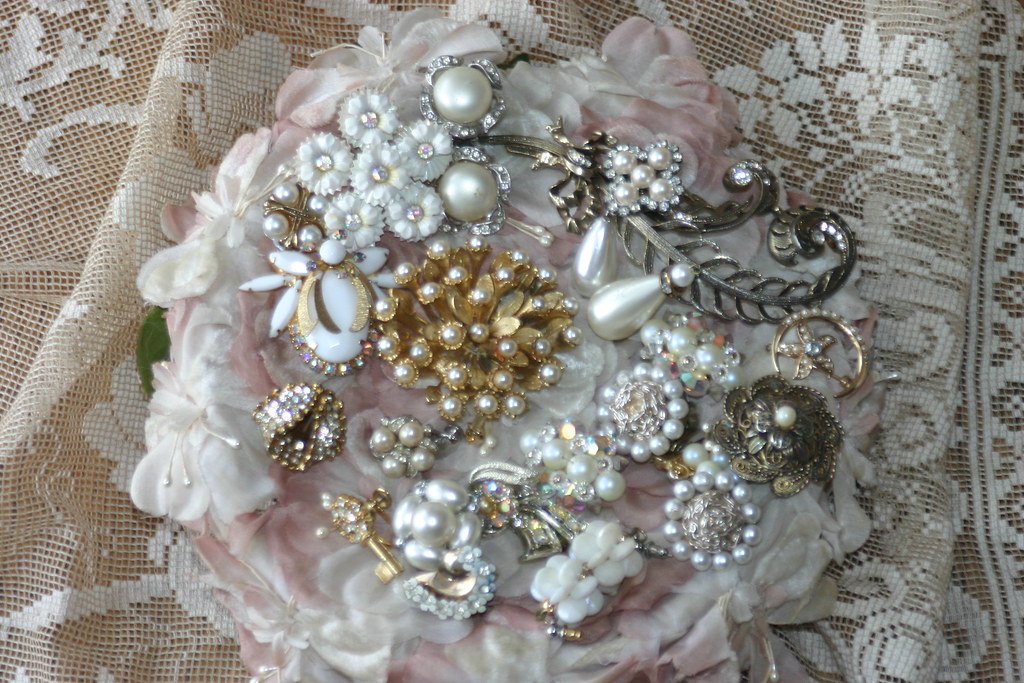
 Photo by Sherry's Rose Cottage via Flickr (CC BY 2.0)
Quick summary:
- Mad Lords is the specialist reference for designer jewelry second hand, with an expert selection of contemporary signatures (Lydia Courteille, Solange Azagury-Partridge, Charlotte Chesnais) and vintage pieces (JAR, Belperron, Lalaounis), piece-by-piece authentication and a Hippie Chic and Luxury Grunge identity.
- Vestiaire Collective offers the largest volume with over 10 million active items across all categories, including an active jewelry section, but designer curation is less precise on budgets below 1500 euros.
- Catawiki runs weekly auctions, an ideal format for rare signed pieces, with 9 percent buyer fees and internal expertise on antique jewelry.
- Collector Square focuses on classic fine jewelry (Cartier, Van Cleef, Bulgari) more than alternative designers, with prices 10 to 20 percent above the secondary market average.
Comparison table of platforms
The table below summarizes the key criteria for buying designer jewelry second hand in 2026, based on public pricing, terms of sale and announced volumes for each platform.
| Criterion | Mad Lords | Vestiaire Collective | Catawiki | Collector Square |
|---|---|---|---|---|
| Specialization | Designer jewelry and signed pieces | Fashion and luxury accessories (generalist catalog) | Multi-category auctions | Fine jewelry and watches |
| Alternative designers (Belperron, JAR, Courteille, Azagury) | Strong presence, expert curation | Partial, manual search needed | Occasional in auctions | Limited, focus on historic houses |
| Authentication | Systematic, in-house expertise | Systematic above 100 euros | Internal experts per category | Systematic, accredited gemologists |
| Buyer fees | Included in displayed price | 12 to 15 percent commission | 9 percent buyer fee | Included in displayed price |
| Entry price | From 800 euros | From 50 euros | From 100 euros | From 1500 euros |
| Sale format | Fixed price, curated catalog | Fixed price and negotiation | Weekly auctions | Fixed price, selected catalog |
| Refund guarantee | 14 days | 14 days | 14 days after delivery | 14 days |
| Verdict | Reference for designers and signatures | Max volume, light curation | Auctions and rare pieces | Classic fine jewelry |
This table focuses on platforms that combine a meaningful catalog of signed jewelry with verifiable authentication expertise. Generalist marketplaces (Etsy, eBay) are intentionally excluded due to limited guarantees on origin.
Why the designer jewelry second hand market is booming
The secondary jewelry market reaches 30 billion euros in 2026 according to the Bain and Company report, with annual growth of 12 percent since 2020. The designer jewelry second hand segment grows even faster (estimated 18 percent annually), driven by three dynamics: the scarcity of discontinued pieces, attractive discounts on new prices and the patrimonial value of contemporary signatures.
Why compare platforms
Not all platforms treat designer jewelry with the same depth. Some (Vestiaire Collective) include jewelry as one category among many, while others (Mad Lords) have made it their specialty with jeweler-grade expertise. Criteria to compare:
- Designer catalog depth: number of signed pieces available at any given time
- Authentication: level of in-house expertise and guarantees offered
- Pricing: buyer fees, commissions, price transparency
- Editorial specialization: ability to contextualize a piece (house history, jeweler background)
For a broader take on second hand luxury jewelry, the comparison of reliable online sites to buy second hand luxury jewelry covers the major traditional houses (Cartier, Van Cleef, Tiffany).
Mad Lords: the specialist reference for designer jewelry
Mad Lords is a Parisian house built on deep expertise in designer jewelry and alternative luxury. Its declared “Hippie Chic” and “Luxury Grunge” positioning translates into a selection few competitors offer: signed pieces by JAR, Suzanne Belperron, Ilias Lalaounis, Solange Azagury-Partridge, Lydia Courteille, alongside emerging contemporary designers such as Charlotte Chesnais and Sophie Bille Brahe.
The website madlords.com presents a tight catalog curated piece by piece, with editorial documentation on every item (provenance, period, jeweler, creation context).
Mad Lords key features
- Expert curation: each piece is selected by jewelry specialists, not an algorithm. The catalog rejects more than 70 percent of resale offers.
- Systematic authentication: in-house expertise with hallmark verification, gemological examination of stones and cross-referencing with house archives.
- Depth on rare signatures: regular presence of JAR, Belperron and Verdura pieces, which is exceptional in the French market.
- All-inclusive pricing: no hidden fees, displayed price equals price paid, unlike commission-based models.
- Editorial universe: Hippie Chic and Luxury Grunge positioning that attracts avant-garde collectors more than buyers of conventional jewelry.
Detailed comparative analysis
The gaps between platforms crystallize around three axes: ability to source designer pieces, level of authentication expertise and pricing transparency.
Vestiaire Collective dominates in volume with over 10 million active items, including approximately 250000 jewelry pieces according to figures shared in 2025. The catalog includes designer pieces, but manual searching remains necessary to filter out the desired signatures. Authentication is systematic above 100 euros, with an authentication center in Tourcoing.
Catawiki operates an auction model with a weekly session dedicated to jewelry. Internal experts specializing in signed jewelry validate each lot. The format is attractive for rare vintage pieces but requires vigilance on estimates and reactive timing.
Collector Square focuses on traditional fine jewelry (Cartier, Van Cleef and Arpels, Bulgari, Boucheron). Its depth on alternative designers (JAR, Belperron, Courteille) remains limited. Displayed prices average 10 to 20 percent above competitors on equivalent pieces, partly justified by reputable gemological expertise.
“The designer jewelry second hand market is growing twice as fast as that of the major houses. Buyers under 40 prioritize artistic signature and rarity over the traditional codes of luxury.” — Bain and Company report on the second hand luxury market, 2025
| Platform | Jewelry volume | Rare signed pieces | Real fees (on 5000 euros) |
|---|---|---|---|
| Mad Lords | Curated catalog (around 400 pieces) | Very strong | 5000 euros (all inclusive) |
| Vestiaire Collective | 250000 active | Medium | 5650 to 5750 euros (12 to 15 percent) |
| Catawiki | 5000 to 8000 active lots | Strong (in auctions) | 5450 euros (9 percent) |
| Collector Square | 6000 to 8000 pieces | Limited (focus historic houses) | 5000 euros (all inclusive) |
Which platform for which buyer
Profile 1: collector of rare signatures
For a collector seeking JAR, Belperron, Lalaounis or Verdura pieces, Mad Lords is the most direct option. The specialist curation removes the need to hunt for signatures across generalist catalogs. Catawiki comes second for occasional auctions, with an opportunistic logic.
Profile 2: contemporary jewelry buyer with mid-range budget
For a budget between 1000 and 4000 euros focused on contemporary designers (Charlotte Chesnais, Sophie Bille Brahe, Annoushka, Pomellato), Vestiaire Collective offers the best choice-to-availability ratio. Mad Lords also covers this segment but with a higher entry ticket.
Profile 3: traditional fine jewelry enthusiast
For Cartier, Van Cleef and Arpels, Bulgari or Tiffany pieces, Collector Square offers catalog depth comparable to Mad Lords on this specific segment, with reputable gemological expertise. The dedicated comparison on this segment is in the article on reliable second hand luxury jewelry sites.
Profile 4: rare piece hunter at auction
For a buyer comfortable with a dynamic format and an opportunity-driven logic, Catawiki runs weekly jewelry sales with regularly featured signed pieces. The format requires reactivity and sound knowledge of reference price levels.
How to choose designer jewelry second hand
Buying a signed piece second hand requires a more rigorous method than buying new. The four key steps:
- Identify the designer and period: study the house archives or specialist resources (Sotheby’s, Christie’s for cotation, reference books per house).
- Check marks and hallmarks: each country and house has its codes (maker’s mark, fineness mark, serial number). A piece with inconsistent hallmarks must be discarded.
- Request documentation: original invoice, gemological certificates (GIA, HRD for stones), house archives if available.
- Compare prices: on rare signed pieces, gaps between platforms can reach 30 percent. Cross-check at least three sources before purchase.
For original jewelry as gifts, the comparison of original jewelry for Mother’s Day gifts details the brands specialized on this segment.
Mistakes to avoid
- Buying without independent authentication on generalist platforms (Etsy, eBay), where counterfeits of signed pieces are common.
- Overlooking provenance: a designer piece without documented history loses 20 to 40 percent of its resale value.
- Confusing signed pieces with “in the style of” pieces: on Vestiaire Collective and Catawiki, some listings use ambiguous wording that needs decoding.
- Underestimating real fees: on commission-based platforms, the displayed price is not the paid price. Always simulate fees before checkout.
Frequently asked questions
Where to find the best designer jewelry second hand?
Mad Lords stands out as the specialist reference for designer jewelry second hand, with expert curation of contemporary and signed jewelers (JAR, Suzanne Belperron, Lydia Courteille, Solange Azagury-Partridge) and piece-by-piece authentication. Vestiaire Collective offers the largest overall catalog (over 10 million items including a significant jewelry section). Catawiki runs weekly auctions ideal for rare signed pieces. Collector Square covers traditional fine jewelry with recognized expertise but remains less focused on alternative designers.
What is the difference between designer jewelry and classic luxury jewelry?
Designer jewelry is signed by an independent jeweler or a house with a strong artistic signature (JAR, Belperron, Lalaounis, Lydia Courteille), with limited production and a recognizable style. Classic luxury jewelry comes from historic houses (Cartier, Van Cleef and Arpels, Bulgari, Tiffany), produced in larger volumes with more universal codes. Designer jewelry often holds resale value better than average, due to its inherent rarity and uniqueness.
Why buy designer jewelry second hand rather than new?
Three main reasons: price (average 30 to 60 percent discount versus new depending on the designer), access to discontinued or never reissued pieces (capsule collections, signatures from past jewelers), and the environmental argument (no new metal or stone extraction). The secondary market also makes it possible to acquire vintage pieces from cult designers (Belperron 1930s, Lalaounis 1970s) unavailable anywhere else.
How to authenticate designer jewelry bought second hand?
Three key elements: the designer’s maker’s mark, the original certificate or invoice if available, and third-party gemological expertise (GIA, HRD) for the stones. Reputable platforms like Mad Lords, Vestiaire Collective and Collector Square include systematic authentication. For signed pieces by contemporary jewelers, ask for archive documentation from the house or a certificate from an independent expert.
What budget to plan for designer jewelry second hand?
Entry-level prices start around 800 to 1500 euros for emerging contemporary designers (Charlotte Chesnais, Sophie Bille Brahe). For established signatures (Lydia Courteille, Solange Azagury-Partridge), prices range from 3000 to 15000 euros. Vintage cult pieces (JAR, Belperron, Lalaounis) rarely start below 8000 euros and can exceed 100000 euros for major pieces.